A newly placed slab can look pale and dry while the material underneath is still changing. It can also stay visibly damp while developing useful properties. Those observations are not contradictory. Curing and drying describe different parts of a concrete project, and confusing them makes questions about coverings, coatings and opening dates harder to answer.
The useful distinction is simple: curing manages conditions for the cementitious material to develop, while drying describes moisture leaving the material. Neither the colour of the surface nor the number of days on a calendar measures every property that matters. A clearer project conversation separates what has been done from what has actually been measured.
Start with three different processes
Hydration is a chemical reaction between cement and water. Setting describes the transition away from a workable fresh mixture. Drying involves moisture moving toward the surroundings. These processes can overlap, but they are not interchangeable. Saying that a slab is “drying nicely” does not establish how far hydration has progressed, just as saying that it has set does not establish its final strength.
The American Concrete Institute explanation of curing emphasizes maintaining moisture and temperature conditions so the intended properties can develop. That definition helps avoid a common misunderstanding: water is not merely an inconvenient liquid that must disappear. It is also a reactant needed in the development of the cement paste.
Consider two identical notebooks for a fictional patio. One records the date, air temperature and whether the surface looked dry. The other records placement details, the curing method, its start and finish, and any agreed inspection or testing. The second notebook supports a better discussion because its entries describe decisions and evidence, rather than using appearance as a substitute for both.
Follow the competing paths taken by water
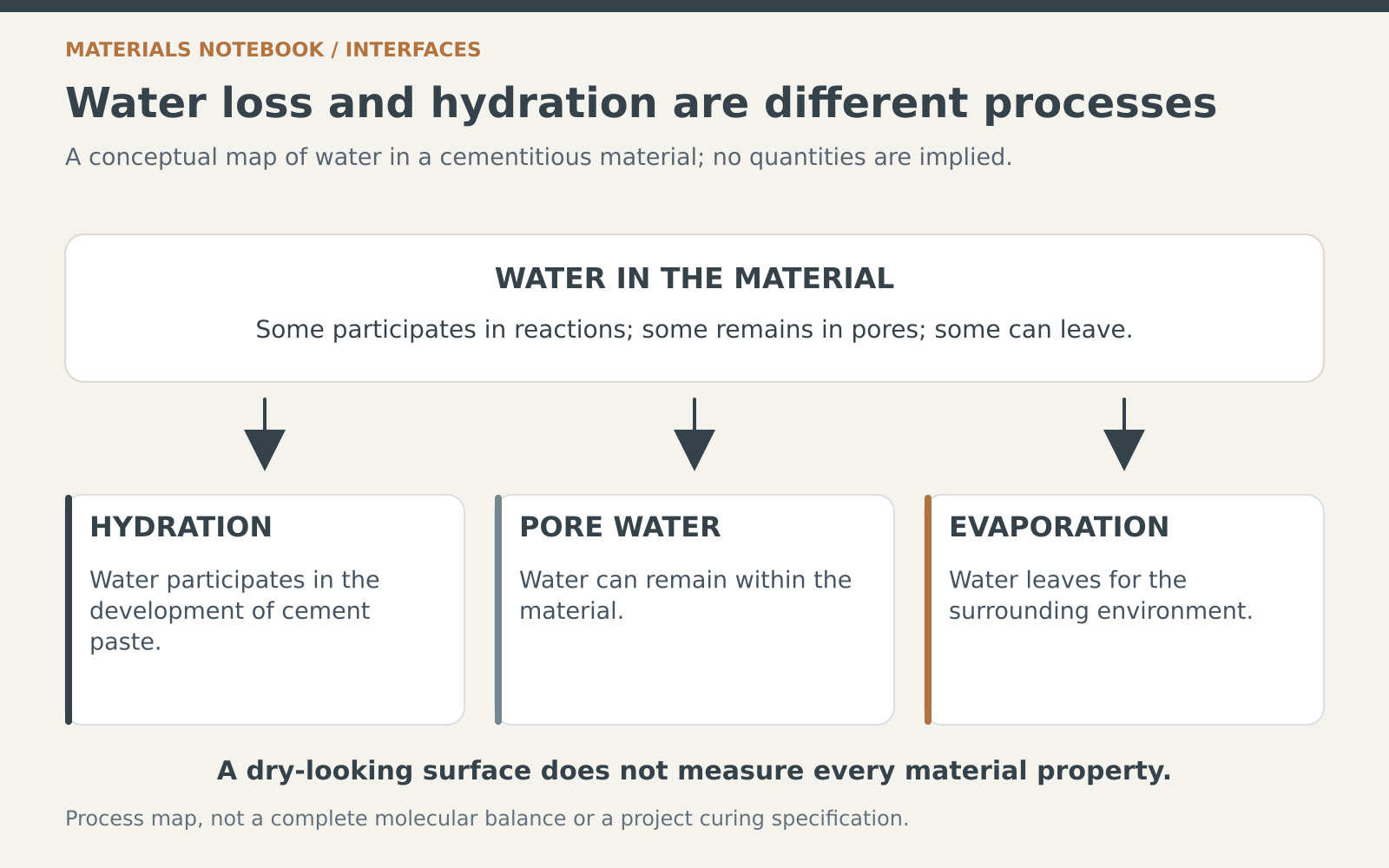
Some water participates in hydration; some remains in pores; some can evaporate. These are useful categories for thinking, rather than a complete accounting system for every molecule. The important point is that evaporation removes water from the material without automatically producing the same changes as hydration. Faster water loss is therefore not a universal shortcut to a better slab.
A NIST study of drying and hydration during curing describes the competition between these processes for mixing water. It examines moisture behaviour within cement paste, reminding readers that the surface is only one part of the specimen. A breeze across the top and the conditions deeper inside need not produce identical histories.
This distinction also explains why a single photograph is a weak record. A photograph may document the presence of a covering, an exposed edge or a visible crack. It cannot show the internal moisture distribution or reconstruct the full temperature history. Use pictures for what they reveal and written records for what they cannot.
Separate the next tasks on the programme
“Ready” needs an object. Ready for a person to walk across a surface, ready for construction loads and ready for a moisture-sensitive finish are different questions. Each should be connected to the project specification, material requirements and responsible professional. Giving every task one generic waiting period hides those differences.
For example, imagine a contractor planning three follow-on activities: removing temporary protection, delivering heavy materials and applying a floor covering. A reasonable planning sheet gives each activity its own requirement and person responsible for confirming it. It does not assume that completion of the first activity authorizes the other two. That is a scheduling principle, not a proposed construction specification.
- Name the intended next activity.
- Record the relevant requirement or manufacturer’s instruction.
- Identify the evidence needed to satisfy it.
- Assign someone to confirm that evidence before proceeding.
This format is useful even when no numerical test is required. It turns a vague question such as “Is the concrete done?” into a specific decision that somebody can answer and document.
Read a curing record without guessing at results
A record should distinguish observations from conclusions. “Covering lifted at the northeast corner” is an observation. “Concrete has inadequate strength” is a conclusion that the observation alone cannot establish. Recording the first accurately allows the project team to decide whether further inspection or testing is appropriate.
The same discipline applies to weather. “Hot afternoon” is much less useful than a dated record made with the agreed measuring method. Do not retrofit precision by estimating values weeks later. If a measurement was not made, mark it as missing. An honest gap is easier to evaluate than a confident number with no traceable origin.
Keep changes visible too. If the curing approach was altered, record when, where and why. A patchwork history matters because a slab is not necessarily exposed uniformly. Edges, shaded sections and areas uncovered for other trades can have different conditions. A location sketch can make those differences intelligible without pretending to calculate their consequences.
One particularly helpful record is a handover note between trades. It can say what protection remains in place, which areas are available and who should be contacted before anything is moved. For a fictional interior floor, that might distinguish a permitted access route from a protected work area. The note does not need to predict material properties. It needs to prevent an operational assumption from becoming an undocumented change in exposure. Keeping the material record and the access plan together also helps explain why one part of a slab may later need a different assessment from another.
Use materials language consistently
The language learned here carries into other mineral materials. A solid can develop through chemical reactions, particle rearrangement or precipitation, and water may be involved in different ways. A hard surface does not tell you which process occurred. A useful explanation names the material, the mechanism being proposed and the property measured afterward.
That habit will matter when comparing conventional cement chemistry with biological mineral formation. Both can involve water and minerals, yet that shared vocabulary does not make them the same process. Even within concrete, strength, moisture movement and surface appearance answer different questions. Keeping the terms separate makes later discussions of pores, crystal growth and mineral-binding molecules much easier to follow.
For your next concrete conversation, bring the activity list and the available records. Ask which requirement is being assessed and what evidence supports the decision. That question is more useful than searching for a universal day when all concrete becomes “fully dry.”
 English